Belize Fund’s first Community Grants cohort is complete. From Chunox to Riversdale, fishers, villages and young creatives now have stronger organisations, new skills and livelihoods to build on.
Carlos Arevalo was born in Chunox but grew up in Cayo. When his father died, he came back to the village at 11. Life was hard for him and his mother. He watched the fishermen come home with good money, so he asked his uncle to take him to sea.
“Clear water,” he remembers of that first trip. “I didn’t imagine that the water was like that. It was the first impact I got that I wanted to return again.” After 22 years as a fisherman, he is now the Chairman of the Chunox Fishermen Association (CFA).
People like Carlos have spent their lives closest to Belize’s sea. Yet that connection has not always translated into access to the financing needed to sustain their livelihoods and strengthen their communities.
“Originally, you pretty much had to be an NGO with proper management, proper accounting, proper everything to be able to get these grants,” says Hector Martinez of the Shark Fishers Association (SFA).
After two grant cycles, the Belize Fund for a Sustainable Future recognized that its standard eligibility requirements favoured larger, established NGOs. It introduced Community Grants to expand access to financing for smaller community-based organizations, associations, micro and small enterprises, and youth, women’s and Indigenous groups. Beyond funding, the initiative provides support in proposal writing, financial management and reporting to strengthen organizational capacity.
Through its first cohort, the Belize Fund invested BZ$294,060 across four grassroots projects. With all four now completed, their achievements offer a glimpse of what more accessible financing can make possible for livelihoods, communities and coastlines.
A place to build from
In Chunox, the CFA used its BZ$75,000 grant to build a multipurpose building, open since August 2025, for meetings, training and community events. Renting it out creates a source of income to support the association beyond the grant. Twenty-three people participated in business training, with equipment also provided to support business ventures. While 17 fishers learned to keep catch logs.
For Carlos, new livelihood opportunities must respect fishers’ connection to the water. “Our fishermen say, ‘I am a fisherman. I am from the water,’” he explains. He imagines fishers offering boat tours during closed seasons and wants their voices heard in decisions about marine resources.
On who should lead, he is blunt: “Nobody will take care of their water if it’s not the same person… We have to involve and hear their voice.”
Fishers teaching fishers
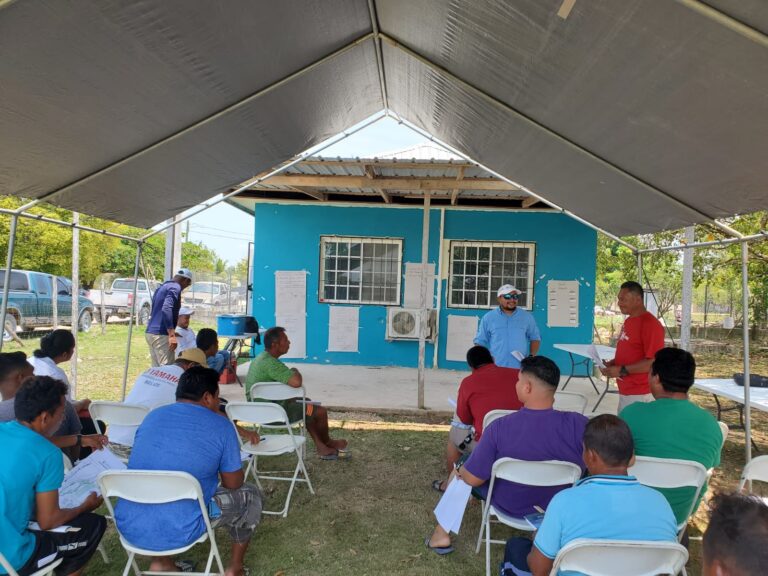
“Fishers receive information better from fishers,” Martinez says.
Reliable catch information helps authorities manage the fishery. Meeting international export requirements also supports continued market access for families whose livelihoods depend on shark fishing.
The work after work
Edgar Deleon of the Three Lagoons Sustainability Program (TLSP) has been bringing village leaders together around community stewardship since 2015. For years, volunteers worked Monday to Friday and gave their weekends to the lagoons. “The hardest, sincerely, was being able to put food on the table for our families and be able to keep consistent,” he says.
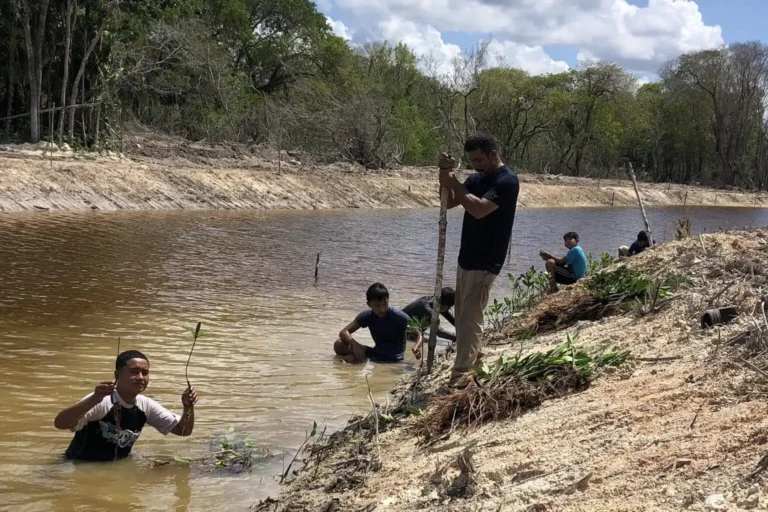
A BZ$75,000 grant helped build the organisation behind that commitment. TLSP equipped an office, trained its board, wrote a five-year strategic plan and signed agreements with four villages and Tradewinds Hospitality. Across six villages, it ran 12 outreaches, 14 cleanups and nine mangrove restoration events.
Its work includes stewardship of the 66-foot reserve along the lagoons. Deleon calls this shoreline buffer “a natural filter that protects the ecosystem,” helping limit sediment entering the water and “keeping our fish for our future generations to enjoy.”
Animation for the coast
Not every blue-economy opportunity begins on a boat.
“We are actually merging what we call the orange economy with the blue economy,” says Jeavon Blancaneaux of Creative Imageries Motion Art Studio (CIMAS). With BZ$74,960, CIMAS trained 20 entry-level animators, 11 of them women, and paid each one for the scenes they completed on Ocean Guardians, an animated series on plastic waste, blue business and marine laws. Four episodes are finished, and a five-town roadshow drew about 600 people.
One trainee, Angele Aguilar, now wants a career in animation, though Belize has no dedicated animation school. “We wouldn’t have been able to have so many young people realise the passion that was actually in them,” Blancaneaux says.
The project brought marine conservation messages to new audiences while giving young creatives paid experience and opportunities in a growing field.
What remains when the funding ends?
Belize’s reefs, mangroves and lagoons support the fish on our tables, the tourism that sustains thousands of livelihoods and the natural barriers that help protect our coastlines. Their significance reaches beyond Belize too. Healthy marine ecosystems support biodiversity, store carbon and add to the resilience of an ocean we all share.
For Edgar Deleon, the hope is that this work outlives everyone involved. “Imagine everybody getting on board,” he says. “We would be seeing the same clean community that we have today a hundred years from today.”
Carlos still remembers the clear water he saw as a boy. Today, his association has a place to gather, skills to build on and new possibilities for earning a living from the sea. What began as one boy’s search for opportunity is now part of a larger effort to help communities shape a sustainable future for themselves.