5th Call For Proposals
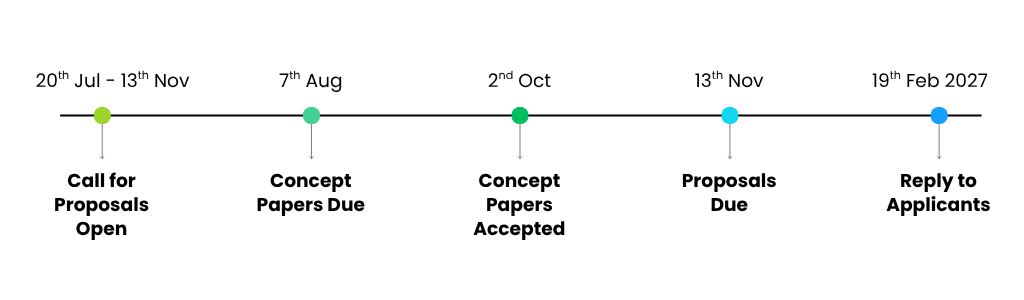
(July 20, 2026 - November 13, 2026)
The Belize Fund invites eligible organizations and community groups to submit a Concept Paper under its 5th Call for Proposals for the 2026–2027 funding cycle. The Call uses a two-step application process. Applicants must first submit a Concept Paper. Organizations with accepted Concept Papers will be invited to develop and submit a full proposal.
Projects should focus on Belize’s coastal and marine environments and contribute to sustainable blue economy livelihoods, resilient coastal and marine ecosystems, and strengthened stewardship and governance of coastal and marine resources.
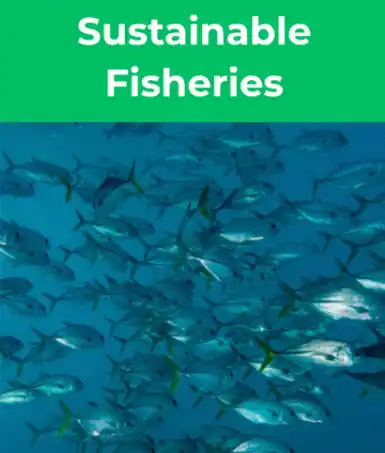
Supports fisheries management programs and initiatives that promote stewardship, sustainable fishing practices, fisheries monitoring, traceability, and rebuilding of depleted fish stocks while strengthening fishing communities and leadership.
Priority areas for proposed projects should include, but are not limited to, one or more of the following:
1. Promote sustainable fishing practices
- Adopt or test sustainable fishing gear (e.g. lobster traps with size-selective grids, Hawaiian sling, barbless hooks for catch and release fishing)
- Integrate advanced technologies such as VMS, satellite tracking, e-logs, acoustic sensors, fish finder, and in-water monitoring to enhance sustainable fishing
- Support initiatives that address invasive marine species while creating sustainable economic opportunities for coastal communities
- Support scientific investigations that inform sustainable fishing practices
- Support citizen science initiatives that complement fisheries monitoring and management efforts.
2. Improve fisheries product traceability
- Enhance product processing, handling, labeling and distribution
- Utilize technological innovations (e.g. VMS, satellite, e-logs) to strengthen traceability and transparency across the fisheries value chain
- Improve fisheries infrastructure and systems that support sustainable harvesting, handling, quality control and traceability.
3. Catch data monitoring programs
- Train fishers on proper data collection
- Conduct data collection of fish stocks
- Support the use of electronic applications for recording catch logs, monitoring, and reporting fisheries data
4. Capacity building for associations and fishers
- Train fishers to monitor and report illegal activities in partnership with co-managers and Fisheries Department.
- Training programs on improved fishing techniques, selective gear, and sustainable fishing methods
- Strengthen fisher participation in fisheries monitoring, compliance, and stewardship initiatives
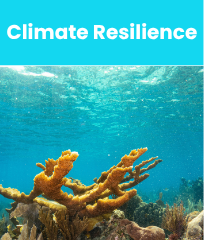
Supports initiatives that strengthen the resilience of coastal and marine ecosystems and communities through climate adaptation, ecosystem restoration, nature-based solutions and sustainable livelihoods.
Priority areas for proposed projects should include, but are not limited to, one or more of the following:
1. Nature-based solutions
- Promote green infrastructure to maintain living shorelines
- Pilot nature-based solutions for shoreline erosion and reef restoration
2. Enhancing Planning and Zoning practices at the village level to support adaptation to climate change
3. Supporting community-led engagement in coastal development, adaptation, and marine spatial
planning processes
4. Building community capacity for monitoring and planning for development
5. Reducing nutrient or sediment loading to prevent marine pollution and protect sensitive ecosystems such as coral reefs, mangroves, and seagrass
6. Community-based ecosystem management and/or restoration
7. Renewable/clean energy/energy efficiency in the fisheries and/or tourism sector
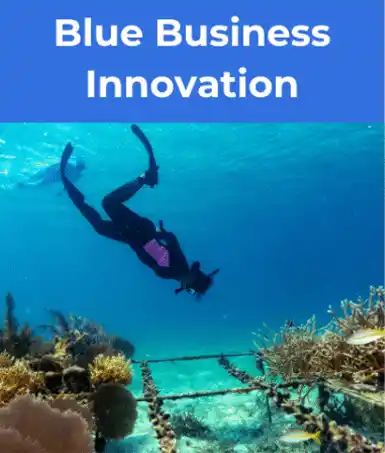
Supports innovative and sustainable blue economy enterprises that contribute to livelihoods, economic growth, women’s participation and youth participation.
Priority areas for proposed projects should include, but are not limited to, one or more of the following:
1. Develop value-added fisheries products
2. Enhance marketability of fisheries products (e.g. ready-to-cook options, improvements in storage, packaging and product quality)
3. Mariculture pilot projects
- Developing and testing sustainable farming or harvesting models for viable species such as seaweed, sea cucumbers, king crabs.
4. Reef-positive tourism and community-based tourism initiatives that promote sustainable visitor experiences while reducing pressure on marine ecosystems
- Tourism practices such as snorkeling, scuba diving, and other water-based tourism activities
that incorporate reef-positive and eco-friendly practices.
5. Circular economy projects that reduce marine litter
- Reducing, reusing and recycling plastics
- Circular economy models and community-based recycling initiatives
6. Value-added marine biodiversity products
- Development of sustainably harvested marine products or by-products such as nutraceuticals,
cosmetics, crafts, and accessories.
Types of Grants
Medium Grant
Awards between
BZ$50,000 and $150,000
Not exceeding 2 year (10% co-financing required)
BZ$50,000 and $150,000
Not exceeding 2 year (10% co-financing required)
Large Grant
Awards between
BZ$150,000 and $500,000
Not exceeding 2 -3 year (25% co-financing required)
BZ$150,000 and $500,000
Not exceeding 2 -3 year (25% co-financing required)
Community Grant
Awards up to
BZ$100,000
Not exceeding 1-2 years (10% co-financing required above BZ$50,000)
BZ$100,000
Not exceeding 1-2 years (10% co-financing required above BZ$50,000)
Eligibility Criteria for Regular Grants
Eligible entities can apply for grants provided that they:
- are a registered entity with the Belize Companies And Corporate Affairs Registry;
- have existed and been operational in Belize for a minimum of one (1) year prior to submission of the application; and
- can demonstrate successful project and financial management.
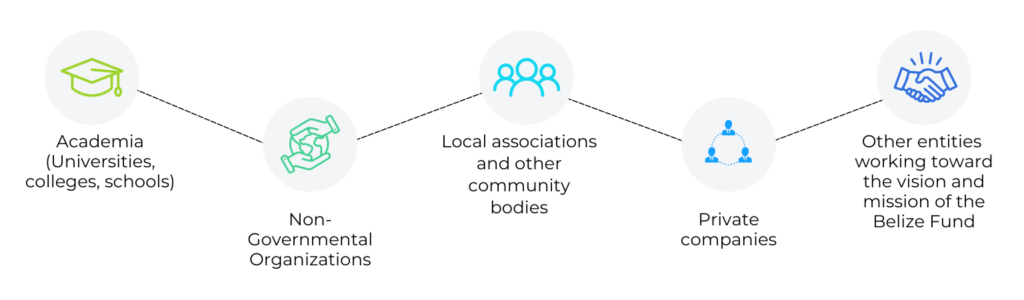
Who can apply for the Regular Grants
Eligibility Criteria for a Community Grant
Eligible entities can apply for grants provided that they:
- are a registered entity with the Belize Companies And Corporate Affairs Registry (even if less than a year);
- located in a coastal community or area;
- active in Belize (must be able to demonstrate activity for at least a year, have a functional governing or executive body conducting meetings regularly)
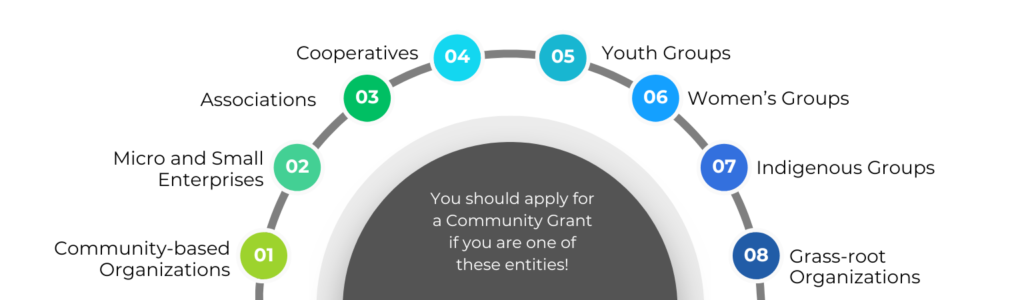
Who can apply for the Regular Grants
Community Grants will prioritize, but not limited to, projects that:
1. Reduce marine litter, plastic waste, or nutrient pollution
- Adopt use of biodegradable products or reusable items
- Develop project based on recycling of plastics
- Reduce use of fertilizers/pesticides and limit them from getting into waterways.
2. Promote stewardship of coastal and marine resources
- Start data collection programs (fish catch data, monitoring of coral bleaching, and ocean health data)
- Assist with monitoring illegal activities
- Build community stewardship for coastal and marine resources (education outreach, community watch groups, community researchers, etc.)
- Build community capacity for monitoring and planning for development
3. Advance blue business development
- Business start ups that depend on the blue space and follow sustainable practices (jewelry from marine products such as conch shell, lionfish fins, seaweed, etc.)
4. Conserve marine ecosystems and restore degraded habitats
- Community mangrove, seagrass and coral reef conservation activities
- Community ecosystem restoration activities
5. Promote nature-based solutions
- Promote green infrastructure to maintain living shorelines
- Pilot nature-based solutions for shoreline erosion and reef restoration
6. Promote sustainable fishing practices
- Adopt or test use of more sustainable fishing gear (e.g. lobster traps with size-selective grids,
Hawaiian sling, etc.) - Adopt size limits to ensure harvest of mature finfish, conch and lobster
- Test voluntary harvest control rules and management quotas
7. Promote eco- tourism and reef-friendly tourism
- Eco-tourism tours that incorporate reef-positive practices
8. Organizational capacity building for fisher groups, community groups, youth and women.
- Training in fishing techniques, fish handling and processing.
- Office management and skills development
- Training on financial literacy, standard business pracces and good governance
Proposal Development Process for Community Grant
Community Grant applicants with approved Concept Papers will receive proposal development support. The Belize Fund will facilitate technical working sessions covering project design, logframe development, budgeting, monitoring and evaluation (M&E), and environmental and social safeguards (ESS) to help applicants develop implementation-ready proposals.
Timeline for 5th Call for Proposals